
What is now worryingly a couple of years ago I said that I’d be doing an infrequent marathon through all my Marvel comic graphic novel collections as well as throwing in the odd highly regarded (or eventually modern) story via the Marvel Unlimited app, and guess what? It’s finally time to make a start, and where better than at the VERY start, I’m talking the 1940s! Yes, Captain America’s original four issues, which contain a couple of stories each, are first up given I’m going through them in original issue release order (as much as I can anyway) and they’re the four featured in the first “Golden Age Masterworks” collection. The next bunch are all origin stories in that they’re the first stories released for a character as well (I only brought a select few relevant Vol.1 Masterwork releases, so don’t panic, you’re not in for a long slog of 60s cheesiness!) and therefore they don’t have an over-arching title, so I’ve just put “Origins” for them, because that’s comic booky, right? Right! So let’s finally make a start then!
The first important to make clear here is that these were released before America actually joined World War II, so the famous cover of Captain America punching Hitler is very direct propaganda before they technically even needed it. It’s a funny thing to keep in mind while reading these issues, but enough of that: this blog / website has always been about me looking at the stories themselves of any given media, not any backstage drama or stuff like that, so let’s do that! Issue #1 shows us Cap’s origin story, which if you’ve watched Captain America: The First Avenger you’ll be very familiar with as it as that stuck pretty close to this original. Steve Rogers is a scrawny guy wishing to do his best and so agrees to undergo a special treatment that involves injecting a drug known only as the “super soldier serum” into him and it transforms him into a muscular man with top-level skills to boot, but the Doctor who created the serum is immediately assassinated. After a few pages of Cap doing some wet work Bucky Barnes just walks into his tent and sees that Captain America is Steve Rogers and right then and there Cap inner-monologues that Bucky must now be his sidekick and despite his young age he must plunge himself head-first into danger alongside him. It’s certainly a quick turnaround for the kid, that’s for sure…

One of the original origins!
After two not particularly funny stories the next highlight of the original issue is the final story involving the Red Skull, though not the Johann Schmidt Red Skull we all know and lo- well, hate, instead this secret Nazi agent is Maxon, the head of an aircraft corporation that was in charge of a plane full of brave airmen that went down at the start of the story. Suffice it to the say Cap gives him a beating! Issue #2 (which sees the debut of Cap’s iconic circular shield) kicks off with Cap and Bucky meeting Betty Ross for the first time while fighting a group of … *ahem* “indestructible oriental giants”, the art for which you’d probably not want to see. They’re defeated by loud noises though, so that’s okay at least! Then they travel to Europe and are actually in the war for the first time! … disguised as an old woman and a child at first, then they follow some spies before unmasking them to the world and punching Hitler and Goring unconscious for good measure! Crazy how much happened in just a few pages really… Cap and Bucky then take out a Nazi spy called “Wax Man”, who literally kills his enemies by encasing them in wax (blimey) and who turns out to be the mayor of the local town when unmasked, Scooby Doo style.

Well, that didn’t take long…
Issue #3 kicks off with the return of the Red Skull, who steals the plans to a massive drill (and kills its creator) and plans to terrorise New York with it. Meanwhile Captain America and Bucky come across a couple of impostors charging people money to take pictures with them dressed as our heroes so the real Cap and Bucky beat them up… then Red Skull mistakes them for the real deal and hangs them both. Bloody hell, that’ll teach them, I guess? Cap tracks Red Skull to his subway hideout and kills Skull by throwing his own bomb back at him, so that’s that! The other highlights of this issues is a story on a film set where the actor who plays a hunchback is actually a Nazi spy who kills some people before Cap (dressed as a knight) punches him a lot, and a proper cheesy story where a villain called “the butterfly” robs a bunch of museums and locks Bucky in a sarcophagus… before getting his head split open by Cap.
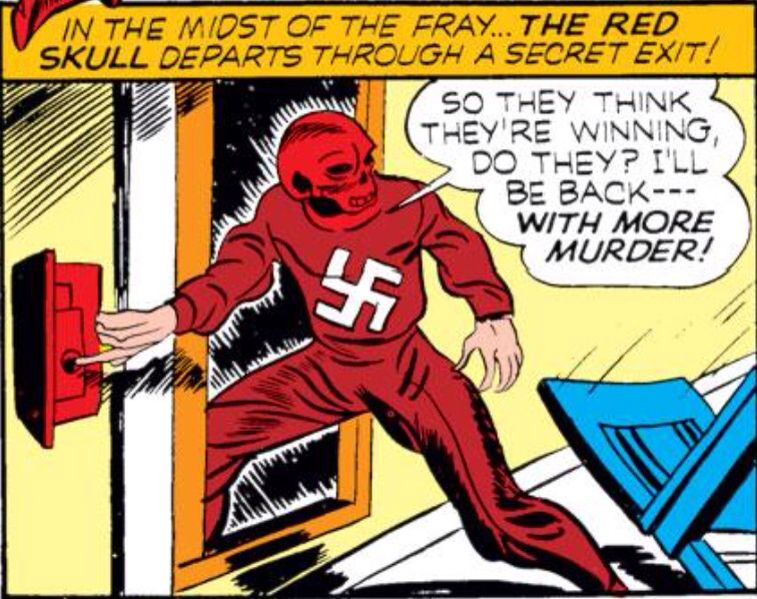
“I’ll be back … with more murder!” is certainly lacking in subtly… then again looking at his outfit I don’t think subtly was ever on his on his mind…
Given the short, serialised nature of these early comics there’s no point in a “spoiler section” so let’s have a look at Issue 4, which kicks off with Cap and Bucky taking on the “Unholy Legion” which is a bunch of homeless people who are, you guessed it, Nazi spies and using deadly weaponry to destabilise America. Cap and Bucky sneak into their stronghold and chase them to the shore where they try to escape by U-Boat but are stopped and brought in to the authorities. The rest is rather dull honestly, a story about some counterfeiters (or “fake money fiends”) and a story at a hospital where patients are disappearing at a time when Bucky happened to need a stay, so he calls Cap in (who arrives at the same time as Betty Ross), who takes out “Doctor Grimm” and his monster Gorro, though the latter proved stronger than Cap so Bucky grabbed a pistol and shot it point blank in the face… Heroic! That ends our only foray into pre-60s comics… I assume, anyway…
Overall Thoughts:
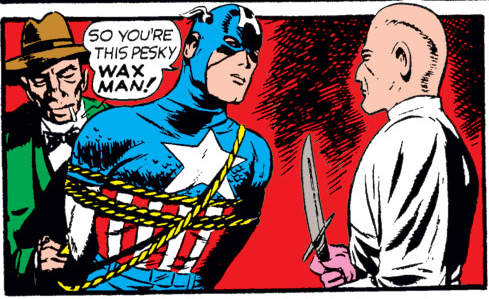
Calling someone who’s murdered a bunch of people by encasing their heads in wax “pesky” is certainly one way of putting it.
The first four issues of Captain America are all about Cap and his “plucky young lad” Bucky unmasking Nazi spies in pre-war America, and so long as you read it knowing what it is it can be a good laugh. I had to space them out, the old fashioned inner-monologue and narration can grate on me a bit, but I did have a cheesy grin on my face throughout. While most people rightfully say the main Marvel “616” continuity began with Fantastic 4 it’s fun to see what was really the earliest adventures of one of its key characters, but I’m not in a hurry to track down the next batch of issues…

 Hogan Reviews