
After skipping forward (or backwards game-continuity-wise!) to MGS3 due to the remake being on the horizon it’s time to get this on-and-off look at the Metal Gear franchise off proper by looking at the very first game in the series. I actually own and played the NES version back in the day so unlike a lot of people who started with MGS on the PS1 this game does hold a lot of nostalgia for me. Okay, I was really bad at the game at the time and the NES version is much worse than the MSX original as it turns out, but regardless it’s always fun to head back here, and thanks to the “Master Collection” it was even easier to play the original AND the NES version on my regular TV this time round. So let’s take a look at the game that started it all.
Background:

Snake hiding behind a wall, waiting to strike, something he’ll do one or two more times across his career… (MSX)
Metal Gear was released for the MSX2 computer on July 13th 1987 in Japan with a release in “parts of Europe” later in the year (not sure which parts had MSX computers, but I guess some did!) before a NES “Port” was released December 22nd 1987 in Japan, June 17th 1988 in the US and at some point in 1989 in PAL territories. Infamously the NES port wasn’t overseen by game producer Hideo Kojima and is generally considered inferior, but more on that later. The game was also ported over to the Commodore 64 in 89/90 in the US/Europe, MS-DOS in 1990 also in the US/Europe, mobile phone devices in 2004 in Japan and 2008 in the US, and released on the Wii Virtual Console at some point as well.
The MSX original and its sequel were included as bonuses on Metal Gear Solid 3: Subsistence on the PS2 which was released on November 17th 2004 in America, December 16th that year in Japan and March 4th 2005 in Europe. Then Subsistence, still with both games unlockable, was given the “HD” re-release treatment, meaning the MSX Metal Gear made its way to the PS3 and XBOX360 in November 2011 in Japan / US and February 3rd 2012 in Europe. But wait: there’s more! The MSX original and the NES version are part of the “Metal Gear Solid: Master Collection Vol. 1” release for PS4, PS5, XBOX Series, Nintendo Switch and PC that came out worldwide on October 24th 2023. So over the three or so decades since the game’s release it’s been made available on a hell of a lot of consoles. Lost media this isn’t!
Metal Gear is one of those “extremely influential” games that rightfully gets talked about all the time when it comes to originating things. It was pretty much the first game to use a stealth mechanic and using a radio to get across more of the story mid-game was an early example of cut-scenes adding more depth to a game’s plot, as at this point story was still mostly told through instruction booklets and an end credit scene if you’re lucky. The series may have disappeared up its own arse by the end but these first few titles mean the series will last forever due to their impact alone.
Gameplay:

Funnily enough a room with a long string of metal barrels constantly rolling back and forth wasn’t a feature that returned in later Metal Gear games. (MSX)
The game takes a top-down 2D perspective segmented into loads of small square screens (think the original Legend of Zelda) where you control Solid Snake as he infiltrates the military base known as Outer Heaven. While you can pick up a gun and start shooting the enemy officers this isn’t a good idea because as mentioned this game pioneered the idea of stealth. If make a loud noise, get spotted by a camera, trip an inferred alarm switch etc. then an alarm rings out and soldiers start pouring into your location and you either have to kill all of the enemies or escape outside of the entire building or head into a lift. The only exception to this is if you’re only spotted by a regular enemy on a normal screen, then all you have to do is move to the next screen and you’re fine. There are ways to deal with enemies quietly though, you can sneak up behind them and punch them until they, um, vanish or shoot them with a silenced pistol, though the suppressor item does have a meter that wears out so you don’t over-use it. Basically the best course of action is to just avoid combat and sneak around guards and underneath cameras as much as possible.
There are moments where you have no choice but to use explosives or loud weaponry, such as creating a path, like using C4 on weak parts of basement walls or firing a remote-controlled missile across an electrified floor to destroy the control panel (two scenarios that will be familiar to those who’ve played Metal Gear Solid!) or boss fights of which there are quite a few, from the likes of someone with flamethrower or a sharp-shooter up to taking on a tank or a Hind D helicopter solo (again, all ideas reused in MGS1 or 3) You also collect items such as rations to restore health, key cards of various numbers to reach different areas of new and old rooms/buildings, gas masks to traverse gas-filled rooms or parachute at one point to escape a roof down to a courtyard (Okay, the parachute is at least never reused, though Snake does abseil from a roof to reach a courtyard in MGS1…basically my point in all these bracketed comments is how it’s funny retrospectively that so much of the original Metal Gear Solid is a remake of Metal Gear!) It has to be said though that some ways to progress are so obscure that without a guide on-hand I have no idea how you were supposed to figure some of it out. Classic 80s gameplay.

Hiding from a security camera via a cardboard box, another thing Snake will be doing a fair amount over the next few missions! (MSX)
About the only thing unique to this game that doesn’t reappear in sequels is Snake having a Star Rating that goes up one for every five hostages he saves during the course of the game. With each of the four ranks Snake we be able to carry more equipment and gain more health but the death of a hostage will take it down, so it’s not permanent. It also has to be stated that having max rank will get you access to a powerful weapon much earlier as one radio contact you can talk to won’t tell you any secrets unless you’re max rank (as she can somehow tell that…) On that point: the radio! As mentioned you can talk to various people, like your boss, um, Big Boss (a character that has only gained more importance as the series progressed!) and other local resistance fighters that can give you info on local creatures or insider info on the base itself. It’s also through this that the story progresses, though to be fair compared to even Metal Gear 2 the story is extremely slight. Still for the time period and it being a non-RPG game it was quite beefy, really!
That’s it for the MSX original, but as for the NES version there are a few changes, to say the least. There are several maze-like jungle levels added to the start and middle of the game with no hints as to how to get through them, the basements floors are turned into a fourth and fifth building to enter instead, the jetpack troops on the roof don’t fly (making them pointless!), the Hind D boss is now a pair of turrets, the Metal Gear mech itself is replaced by a computer terminal guarded by four regular guards, and the game is easier due to no second alert phase where loads of guards pour in, but also harder as enemies don’t drop rations or ammo. So yeah, not a simple port, that’s for sure. It was the version I was used to so I was confused by the lack of jungle at the start when I first saw footage of the original, but I’ll admit to never having got far enough as a child for any of the other major differences to be relevant…
Graphics and Sound:
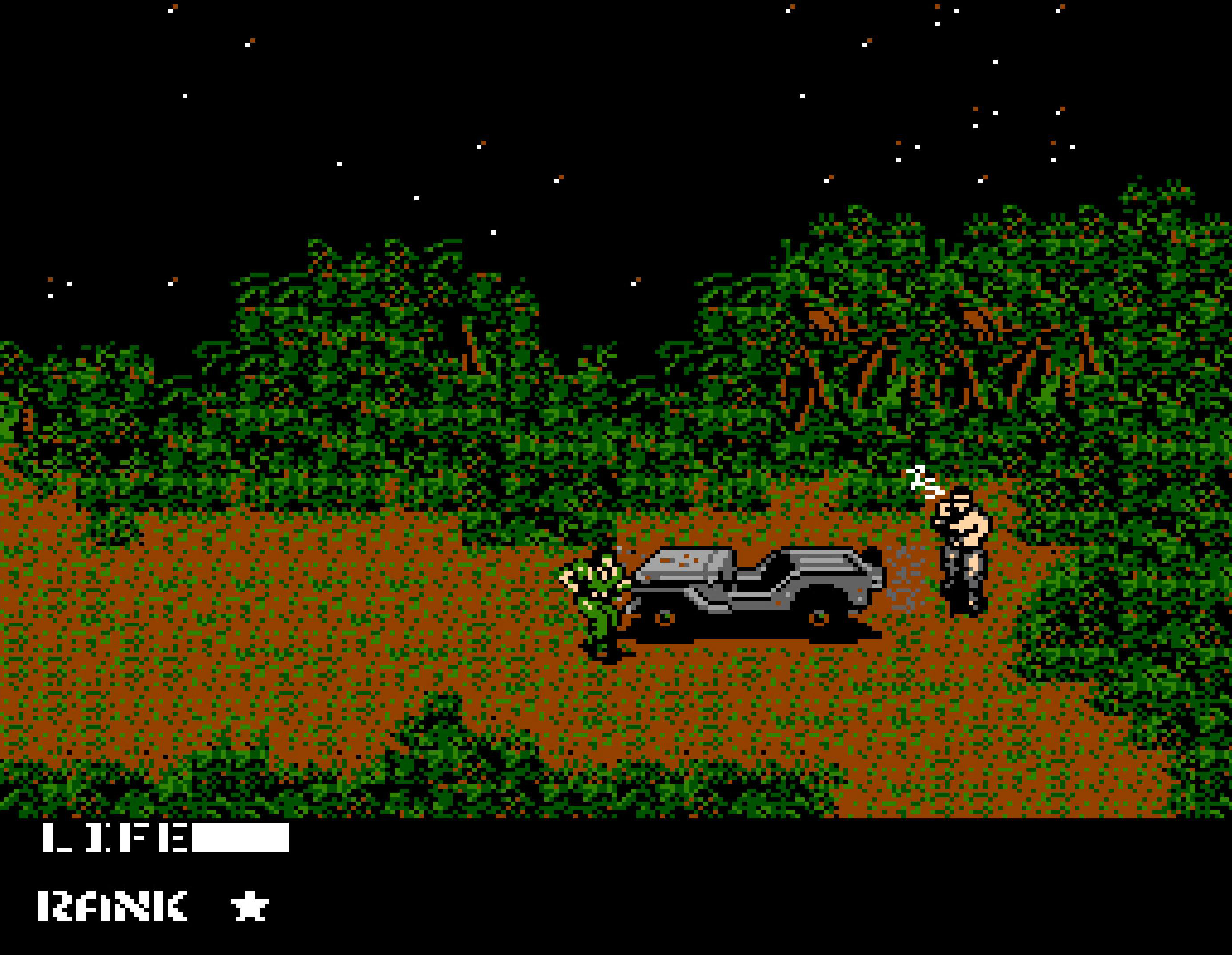
A shot from the opening jungle on the NES version, complete with classic “I Fell Asleep!” guard. (NES… obviously!)
Graphics are perfectly fine for 8-Bit sprite work, colourful outsides, different greys for the insides, soldiers and vehicles stick out and look what they’re supposed to look like… yeah, it’s fine.
Sound is… okay. Sound effects are good (again for the time) although the bleep-de-bleep sound whenever text reads across the screen can be a bit aggravating, and while the now classic “Theme of Tara” that plays throughout 90% of the game is catchy it does also grate on you after a while. Still though, for the time I’m not going to be too harsh.
Story:

“Hello Gray Fox, I’m sure we’ll get along great!” (MSX)
An unknown “famous soldier” has created a base called Outer Heaven and kidnapped famed scientist Dr. Pettrovich along with his nuclear equipped walking battle tank known as Metal Gear. The special forces team known as FOXHOUND have already sent in famed soldier Gray Fox but he was captured, so with no other choice FOXHOUND leader Big Boss sends rookie agent Solid Snake to the base to infiltrate it and rescue Fox. He does so, but Fox soon reveals that Metal Gear is active and must be stopped so Snake pushes forward with his mission, taking out various Outer Heaven mercs like “Shoot Gunner”, who has a shotgun, Machinegun Kid, who has a machine gun (and is probably young?), Fire Trooper, who has a flame thrower, Coward Duck (or “Dirty Duck”) who likes to hide behind human targets and throw boomerangs at his opponents, and two Terminator-like human robots called the “Bloody Brad” units… so not exactly as interesting and varied as the MGS bosses, well, apart from the robot Arnold Schwarzenegger-a-likes.
*Um, spoilers for a many decades-old game from here until otherwise stated!*
After rescuing Pettrovich and his daughter Snake finds out how to destroy Metal Gear and heads there, but as he does he starts getting odd transmissions from Big Boss telling him to go back and that the mission has failed, but he presses on and destroys Metal Gear. As he heads to escape he finds the legendary soldier at the heart of Outer Heaven: Big Boss! He’s been instructing Snake from inside the base the whole time, um… for some reason. Big Boss is defeated and left for dead as the base swiftly explodes.
Why Big Boss didn’t lead Snake into a trap earlier in the run, or even send him into the base in the first place I’ve never been 100% sure. Later retcons reveal that this Big Boss who you defeat and leave in the base as it explodes is actually the body-double “Phantom” of Big Boss you play as in MGSV: Phantom Pain, explaining how he survived this encounter and returned, in that he didn’t survive it as he wasn’t there! That closes one issue with the ending, but still doesn’t explain why Snake was guided to defeat Big Boss and end his plans by Big Boss himself, unless the first Big Boss for most of the game was the actual Big Boss trying to fake his own death using his Phantom and the Big Boss towards the end is the Phantom, tapping into the line to try and save himself. That’s a stretch, and only makes sense now as the Phantom has been created, so doesn’t explain why any of this was a thing back in the 80s… *shrug* ah well.
*Spoilers are now over!*
A fairly simple plot, except for the twist at the end, a far cry from future Hideo Kojima efforts, that’s for sure!
Thoughts Then:
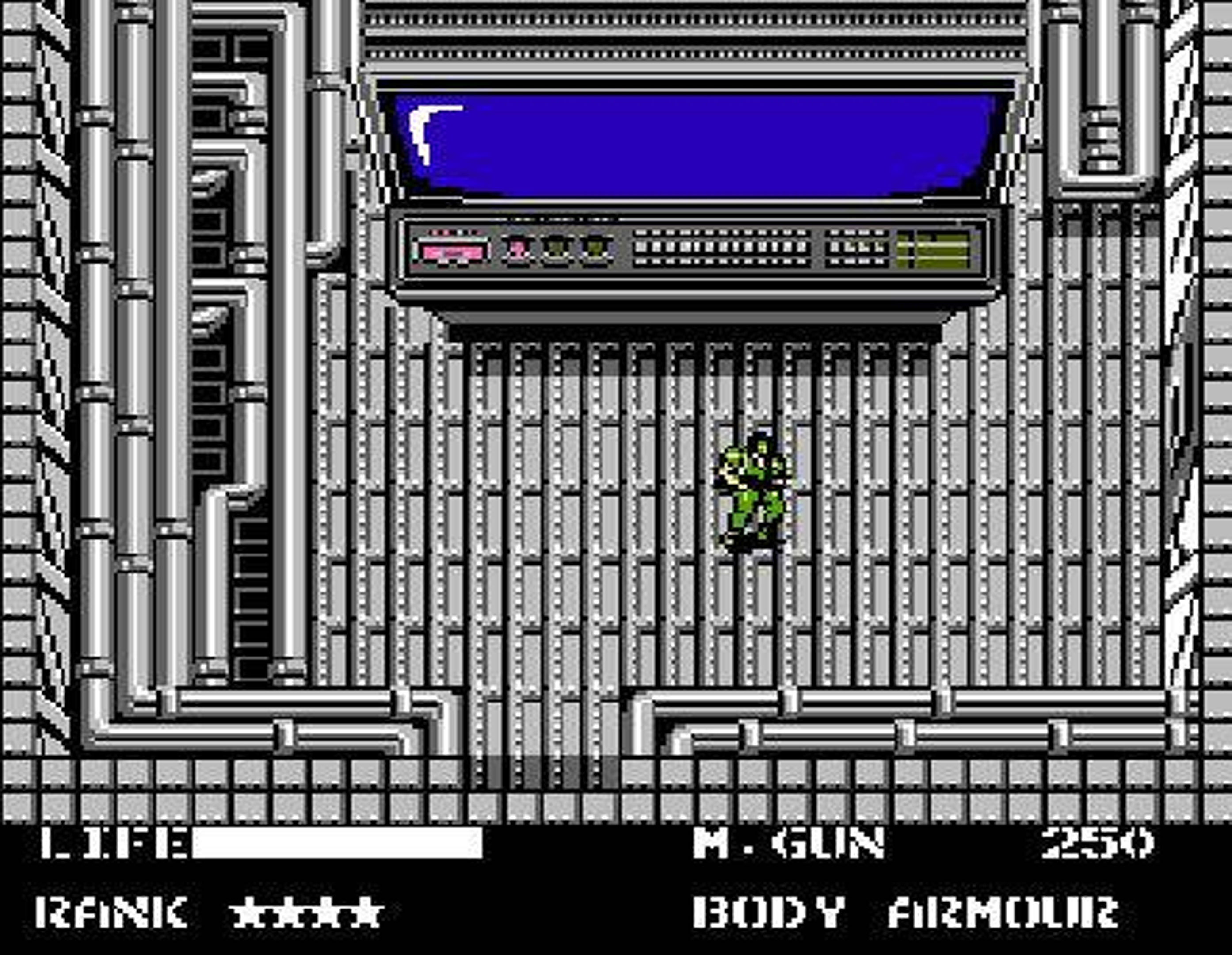
Snake faces off with the terrifying… Metal Gear computer? (NES)
Then as in 1990/91 and the NES version? It was really cool but I didn’t really make it out of Building 1 because I was 7/8 and had no patience whatsoever. I still remember playing the jungle opening a lot and recreating it with my Action Force / GI Joe figures, so it had some impact on me despite both not being from the original MSX game and me not being good at it. Apparently early teen me gave it a 3 on the old excel reviews file, which is fine though I know I didn’t really play it enough to give it a fair rating…

Thoughts Now:

Snake faces off with the terrifying Metal Gear mech! Hooray! (MSX)
I had a blast playing through the original MSX game when I got the HD collection on the XBOX 360, and once again enjoyed myself playing it for this review on my PS5, but it has to be said that both times I had to use a guide because its one of those games where nothing is made obvious and guideless you’ll end up spending hours wandering around not knowing what to do. I hate playing a game with a guide open, it feels like it defeats the purpose, but it is what it is and it’s still a fun game to play through.

 Hogan Reviews