
Persona 3: Reload came out around the same time as Final Fantasy VII: Rebirth back in February and I knew I’d only have the time for one so I chose the latter, but come mid-June I knew I had a good stretch of time with no new major releases I was interested in and so finally got round to purchasing it, and you know what? It’s actually quite hard which of the two RPG remakes I liked more. P3 has always appealed to me but I never actually played it, I saw a friend play through about a third of it and watched (and reviewed!) the four movie adaptations, plus played the Persona 4: Arena games that featured the P3 cast, so I was very familiar with it and really enjoyed the characters and setting but this was actually my first time playing the whole story myself. So let’s take a look!
Background:
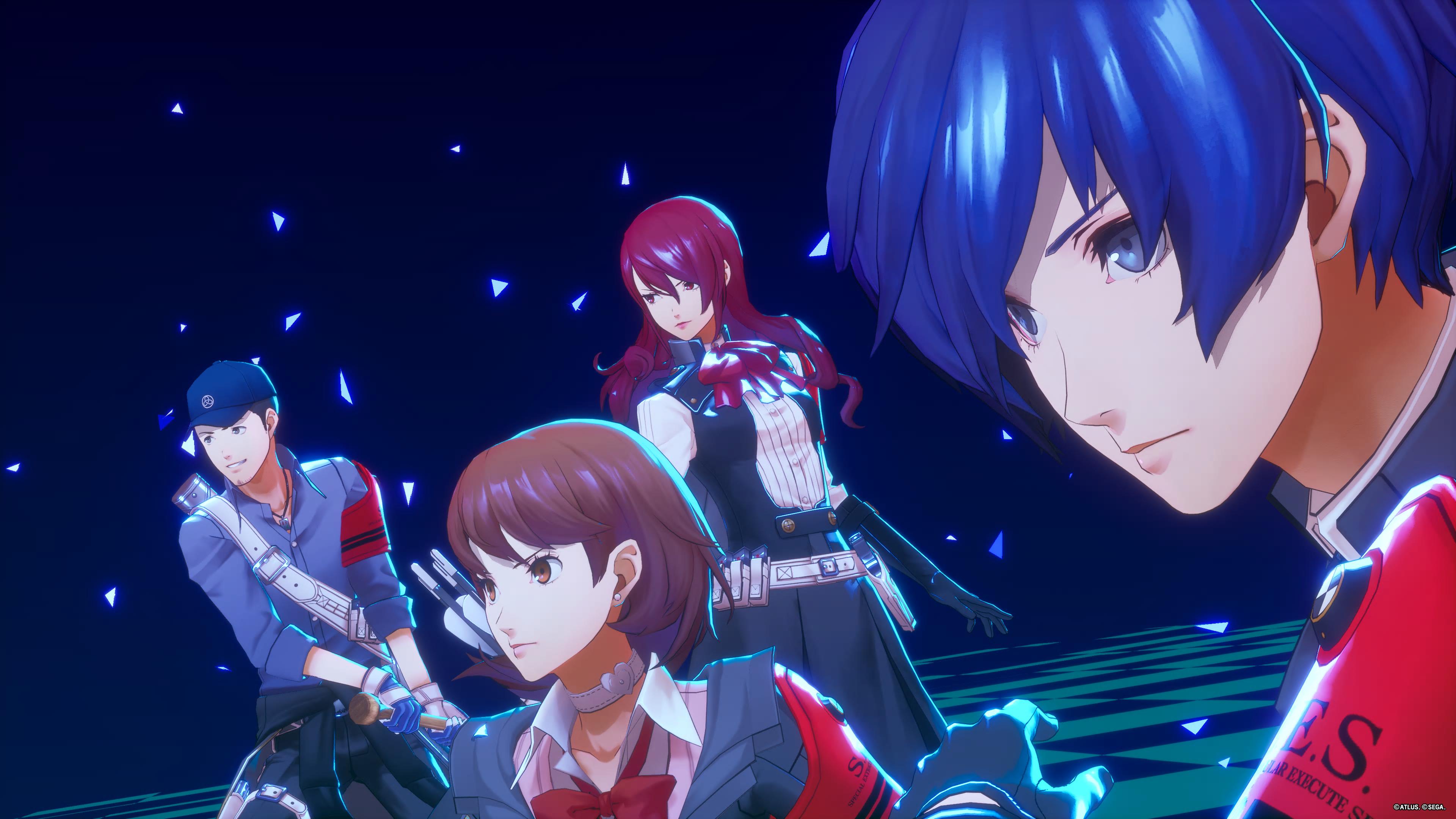
Going for an All Out Attack to open the review up!
Persona 3: Reload was released worldwide on February 2nd 2024 for PS4, PS5, XBOX One, XBOX Series and PC. As you might gather it’s a from-the-ground-up remake of Persona 3, which itself was released back in 2006 in Japan, 2007 in the US and 2008 in Europe for the PS2, with an enhanced re-release titled “Persona 3: FES” released in Japan in 2007 and everywhere else in 2008 (including Europe, P3 was February 2008, FES was October 2008… talk about peeved if you brought the first one!) this was also for the PS2. It added a new epilogue chapter to tie the story up that will be coming to Reload as DLC in September.
Finally there was Persona 3: Portable, which was stripped down in terms of environments making a lot of it more like a visual novel but did add a female protagonist option that is missing from this version (unsurprisingly given this is far from a visual novel!) it was released on the PSP in 2009 in Japan, 2010 in the US and 2011 in Europe, then re-released digitally on the PS4, Switch, XBOX One and PC on January 19 2023. I had it on my PS wishlist since then, glad I didn’t end up getting it over the course of 2023 given this game’s release!
Gameplay:
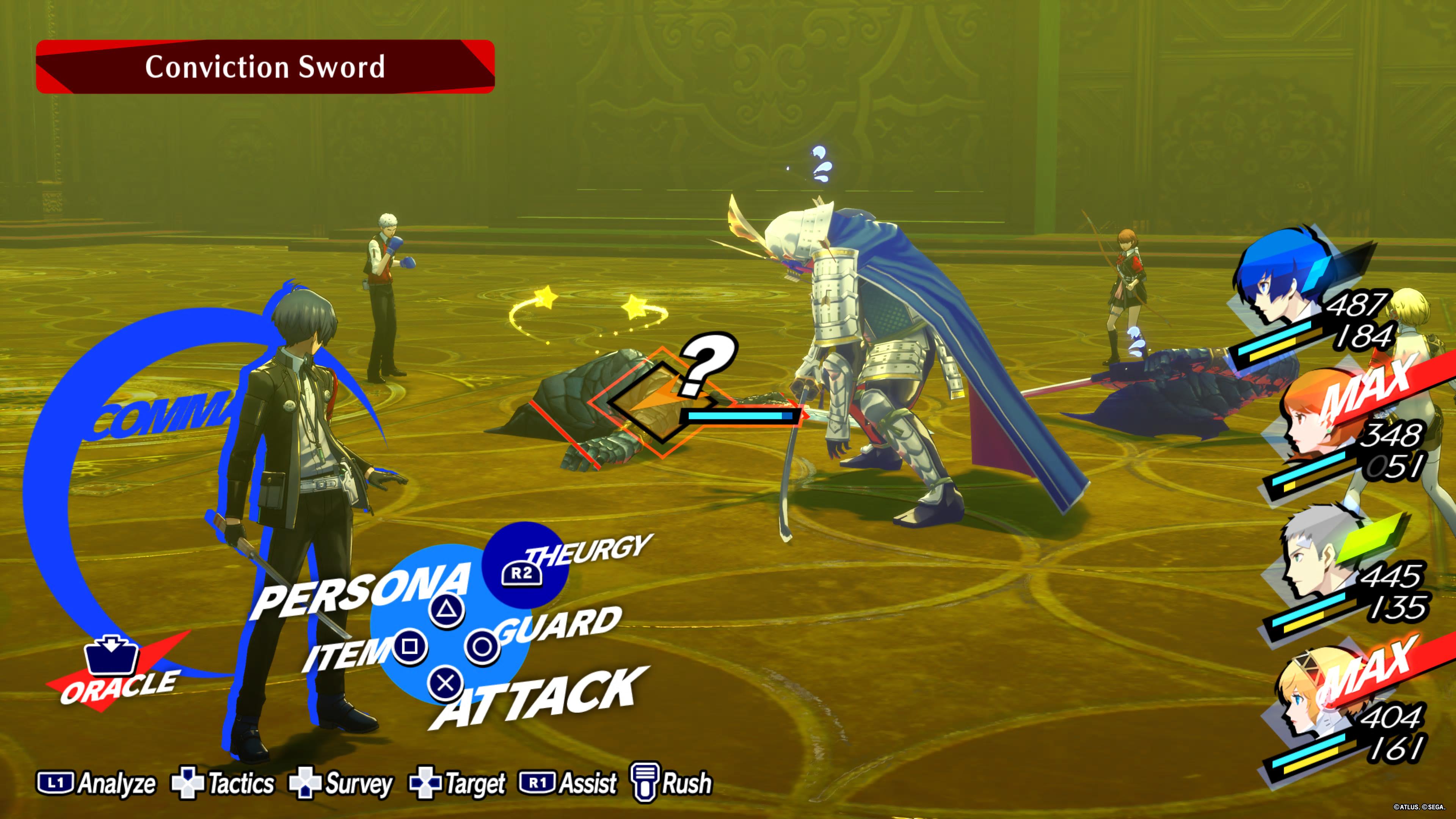
That’s one visually pleasing HUD!
Persona 3: Reload is every bit a follow up to Persona 5 as it is a remake of a game that came long before P5 as it has added a lot of the improvements and refinements the series has had during the two games in between 3 and 3:R. Basically it’s still the same half turn-based J-RPG and half social life sim experience, but thankfully a lot of the kinks have been ironed out.
Taking a look at the combat first, in the original P3 you only controlled the protagonist and the other party members were AI controlled, that is thankfully a relic of the past as now you can control all four party members. The action is, as I said, turn based and actually turned based not like the “real time action” RPG like a lot of the Final Fantasy games so you can take your time to pick your move without fear of the enemy attacking. On your turn you can physically attack, attack with magic or special physical attacks based on your Persona, block to reduce damage or use an item. While everyone has a specific Persona with one element normally tied too them (Fire, Ice, Electric, Wind, Dark and Holy) as usual the lead character can switch between any number of Personas that he can “fuse” while in the special Velvet Room location, which honestly has a very Pokémon-y “must collect them all” vibe, complete with a Persona compendium, so… it is hard to resist spending an awful lot of time in there… Anyway, your Personas and your enemies both have strengths and weaknesses (until you get to the really high levels, then its just strengths and things that do normal damage…) and if for example you hit something weak to ice with an ice attack it will be “downed”, and if all your enemies are down then you can launch a snazzy “All Out Attack” for major damage.

Running through one of the more psychedelic parts of Tartarus.
The physical damage is broken down into melee and piercing damage as well, which things can be weak too, so it can take a little time to find the weaknesses but when you do a lot of the game’s encounters become easy peasy, just hit them with the right element / strike, All Out Attack them and there you go, you can even “Shift” between party members when you knock your enemy down (like the “baton pass” from P5) so you can get to the next required element attack straight away. Each character has a traditional health bar and “magic meter”, though in this case it’s “SP”, and everyone (apart from bosses) can suffer status ailments ranging from traditional poison and sleep to fear and anger, plus a couple of instant-kill moves, and all of these can be cured, filled back up or revived from by items and spells, including being KO’d except if the main protagonist is knocked out, then it’s automatically game over. This was kind of annoying because I think if I can revive any other party member from being knocked out during the course of battle, why not him? I know he’s the “leader” but I’m pretty sure the remaining party members would be able to think “I should revive him” by themselves…
New and exclusive to Reload is the “Theurgy Attack” system, where each party member has a gauge that fills up over the course of battle and when it reaches max you can unleash a fancy and powerful special attack. How the Theurgy meter builds is dependant on each character’s personality, which makes it a fun to figure out strategies to build it faster… well, apart from Yukari whose way to build her Theurgy gauge is healing people, which is what I primarily used her for anyway so she was pretty much just constantly with her Theurgy attack ready to go! I think that’s it in terms of in-battle stuff but in the lead up to the battles there are still areas to explore before the boss fight each full moon and the dreaded Tartarus to explore. Thankfully the horror stories I’d heard about the original Tartarus were fixed in Reload as one of the main complaints was a stamina system that meant your teammates got weaker and dropped out of exploring as you went on, and that was entirely removed. People only complain about being tired and wanting to go back if they’re low on SP, which you can fix with items anyway. They also visually jazzed up the different floors to make it a bit more visually interesting, but otherwise it’s a long dungeon you explore, including encountering enemies (that you can get an advantage on if you sneak up behind them), looting chests, breaking objects to get items, and fighting special more difficult opponents behind “Monad Doors” for even better loot, with more floors unlocking each time you defeat a boss.

Our protagonist gains two musical notes’ worth of academics by eating fish. …. What?
Randomly or whenever you win a battle with an All Out Attack you get to draw special cards which can grant you a temporary buff, give you more XP, more money or unlock new Personas, plus a few special Arcana cards unlocked as you go that will give most interesting buffs like more XP from Persona fusions or even the ability to pick more than one card each draw. Most of the floors are randomly generated every time you re-enter Tartarus as well, which is fun… if it weren’t for the fact that as the stamina system was removed I normally visited Tartarus twice in between the bosses, once to get to the next checkpoint and once more to free anyone who has ended up captured there by the end of the lunar cycle, and then spend the rest of the time on the social stuff… Speaking of which!
The next big part about the game is what happens outside of battle. As the story moves on you live the life of a normal schoolboy, interacting with school friends, going out for meals, shopping, hanging out at the dorms your in, all that stuff. Each close acquaintance you meet turns into a “Social Link” with ten levels to reach, and each social link connects to an arcana and every Persona in the game is also linked to an arcana, so the higher your social link is the stronger your Personas are that are connected to that arcana, so by being more social you gain strength, a very nice message that makes sense for this game’s core storyline. It was a big enough hit that it was carried through to 4 and 5 as well. At the dorms you can now hang out with your teammates and do activities that will make them stronger in battle, or just give you more background on their history or a deeper look into their personalities.

You think THAT’s bad? I’m playing a game of someone playing a game on a beautiful day during a beautiful day!
You also have three “Social Stats” of Charisma, Courage and Academics, each starting at one and able to go up to 6, with the higher each stat is the more social link opportunities arise. Thanks to being able to do activities both after school and in the evening I got 6s across the board just over half way through the game, so there wasn’t much to it. I hear the evening slots weren’t a thing in the original P3 so I guess that part of the game wasn’t rebalanced! You can also buy items that can heal you in battle from the pharmacy or get stronger melee weapons and armour from the, um, local police officer (great message! I mean he’s helping you save people, but he’s still giving bladed weapons to teenagers in the police station’s back room…) plus some other shops that can get you even rarer weapons and armour using things you collect in Tartarus or by levelling up Personas and other little bits like arcades and restaurants that can increase your social stats or Persona’s power.
That’s it in a nutshell. Boss fight every full moon and the weeks in between are spent either in Tartarus levelling up or moving the story forward / upping your social links by living a comparatively normal life, complete with school holidays and field trips and the like. As always it’s a very fun and rewarding feedback loop and the story is great too, but I’ll get to that later…
Graphics and Sound:

One of the many stylish victory screens that pop up when you win with an All Out Attack.
Presentation-wise it’s hard to fault the game anywhere. It’s learned from Persona 5 in terms of creating menus and HUDs with amazing flair, the character models and enemy / Persona models are great and well stylised. Everything is just smooth as butter no matter what menu or action you’re doing.
Sound is hard to fault too, with great voice acting no matter which language you go with and a fantastic and extremely catchy OST, with some songs remixed from P3 and some entirely new. I still say the P5 soundtrack tops it, but not by much!
Story:
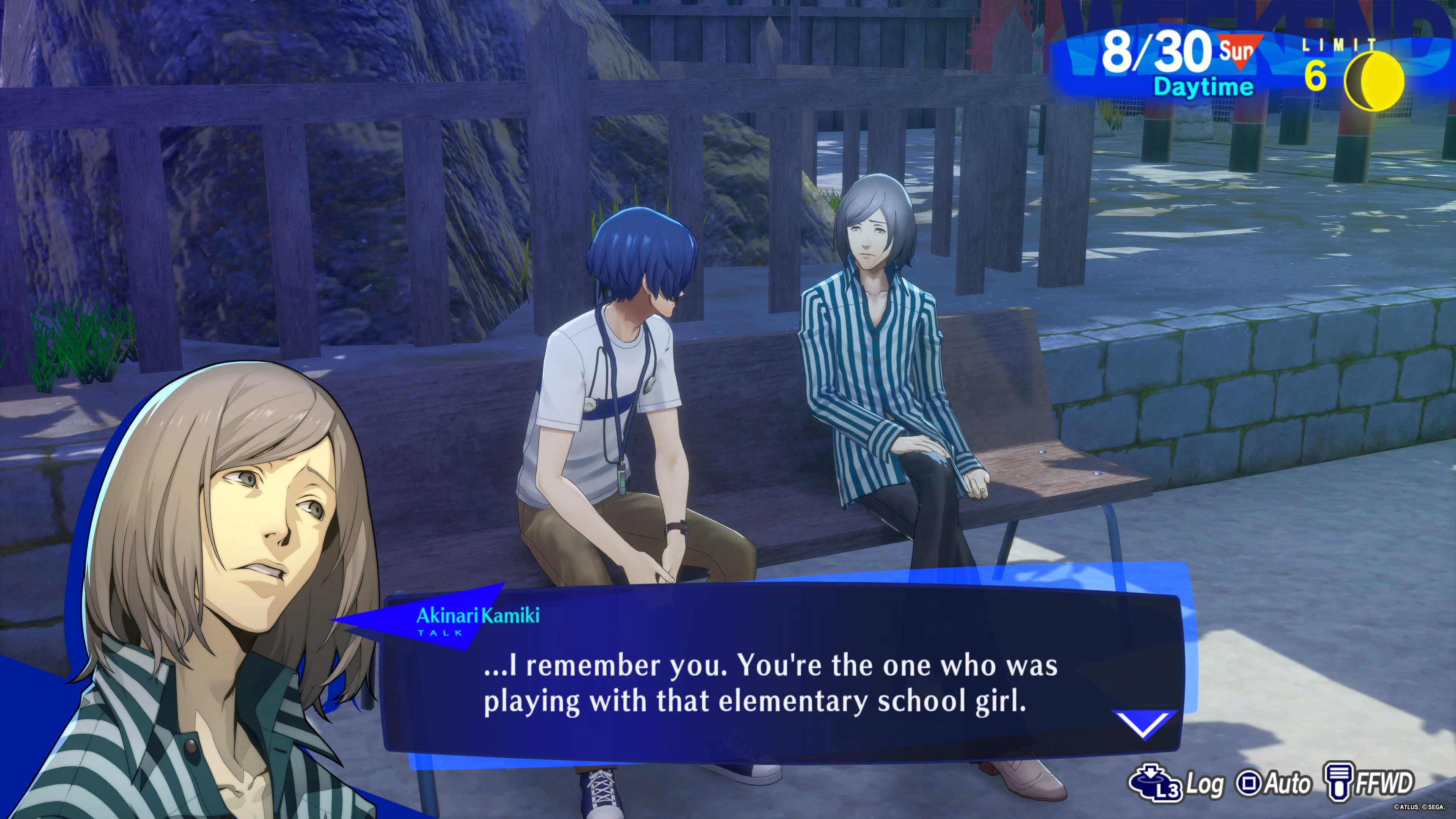
“Um… maybe don’t say that out loud again, please.”
It’s hard to break down an RPG that took me over 80 hours to complete without taking forever, so I’ll give a brief rundown and if you want you can check out my reviews of the four Persona 3 anime films in batches of two HERE and HERE (it’s been seven years but I assume they’re still good?)
The nameless protagonist (called Makoto in expanded media) returns to the place of his birth ten years after his parents died in a car accident and moves into a dorm where he soon gets caught up in their after school activity: the “Specialized Extracurricular Execution Squad”, where they hunt “Shadows” that appear during the “Dark Hour”, an hour in between 11:59pm and midnight that only a few are able to stay awake during. He soon gains the ability of Persona and the SEES are given the task to destroy 12 powerful Shadows, with one or two appearing every full moon, in order to stop the spread of “Apathy Syndrome” that is causing large parts of the population to loose all motivation in life.
The members of SEES are comic relief character Junpei Iori, regular teen girl Yukari Takeba, Akihiko Sanada, the school’s top boxer and overall health-obsessed maniac, Mitsuru Kirijo, a member of a wealthy family who is looked up to by the school for her more mature attitude, Fuuka Yamagishi, a shy and timid girl, Ken Amada, an elementary school kid with a tragic background, Koromaru, a dog who can use the powers of Persona (because why not?) and a very human-like android (which everyone seems to be okay with existing in the mid-2000s) called Aigis who has a thing for our main protagonist but doesn’t understand why. There’s also “cool aloof bad ass” archetype Shinjiro Aragaki and an “evil” counter group to SEES called Strega, as well as a mysterious boy who turns into an equally mysterious teenager called Ryoji Mochizuki. There lot’s of storylines running through the game, especially between Ken and Shinjiro and Junpei and Stega member Chidori, but again I don’t have all day…
*SPOILERS FOR THE ENDING IN BETWEEN HERE AND THE OTHER BOLD SENTENCE*
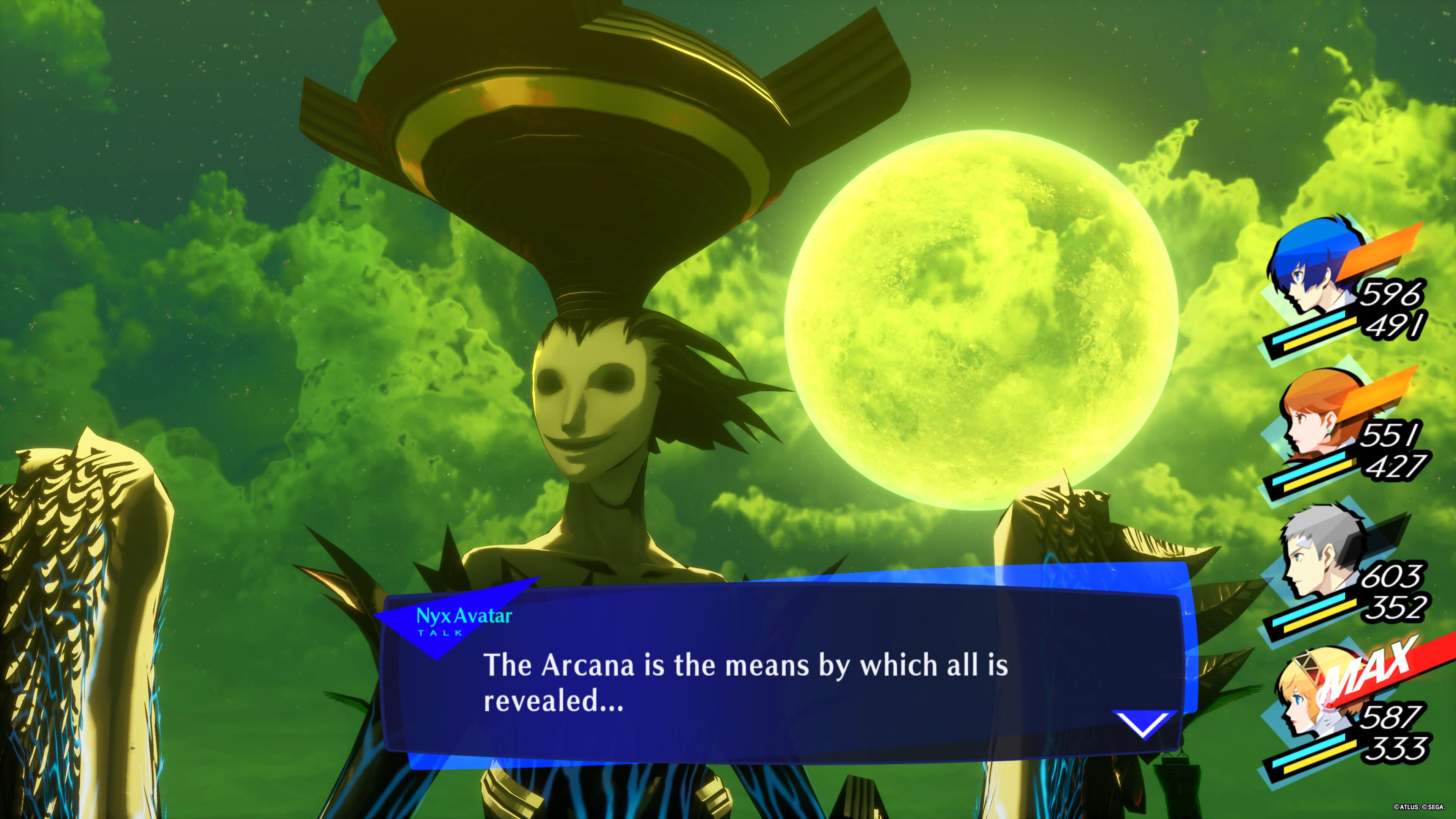
Nyx says this a lot. Best to ignore him.
As it turns there was a deadly shadow with the Death arcana who was cut into thirteen bits 10 years ago by Aigis, with one part being placed inside the protagonist when he was a boy (the car accident being a consequence of the battle between Aigis and Death) and the other twelve being the 12 powerful boss Shadows, and in defeating them all SEES did was reunite them into the one singular being. Ryoji is that being and is actually “The Appriser” who appears and guides an all-powerful being called Nyx to Earth in order to wipe our humanity. Whoops! Luckily everyone manages to find the resolve to face death and continue living (a theme across the game) and they defeat Nyx, though not without our main protagonist making the ultimate sacrifice, much to Aigis’ dismay (and the rest of the cast, but it cuts to credits before we see their reaction) How Aigis and the rest of the cast get over his death is the focus of “The Answer”, which is the FES expansion / forthcoming DLC I mentioned earlier in the review.
*SPOILERS FOR THE ENDING NOW OVER*
Overall it’s a good story, with some really likeable characters and some great moments, but it does take a while to get moving. Someone expecting something more like P4’s murder investigation and multiple palaces or P5’s multiple palaces and major Japan-shaking events might be initially disappointed, but stick with it!
Downloadable Content:
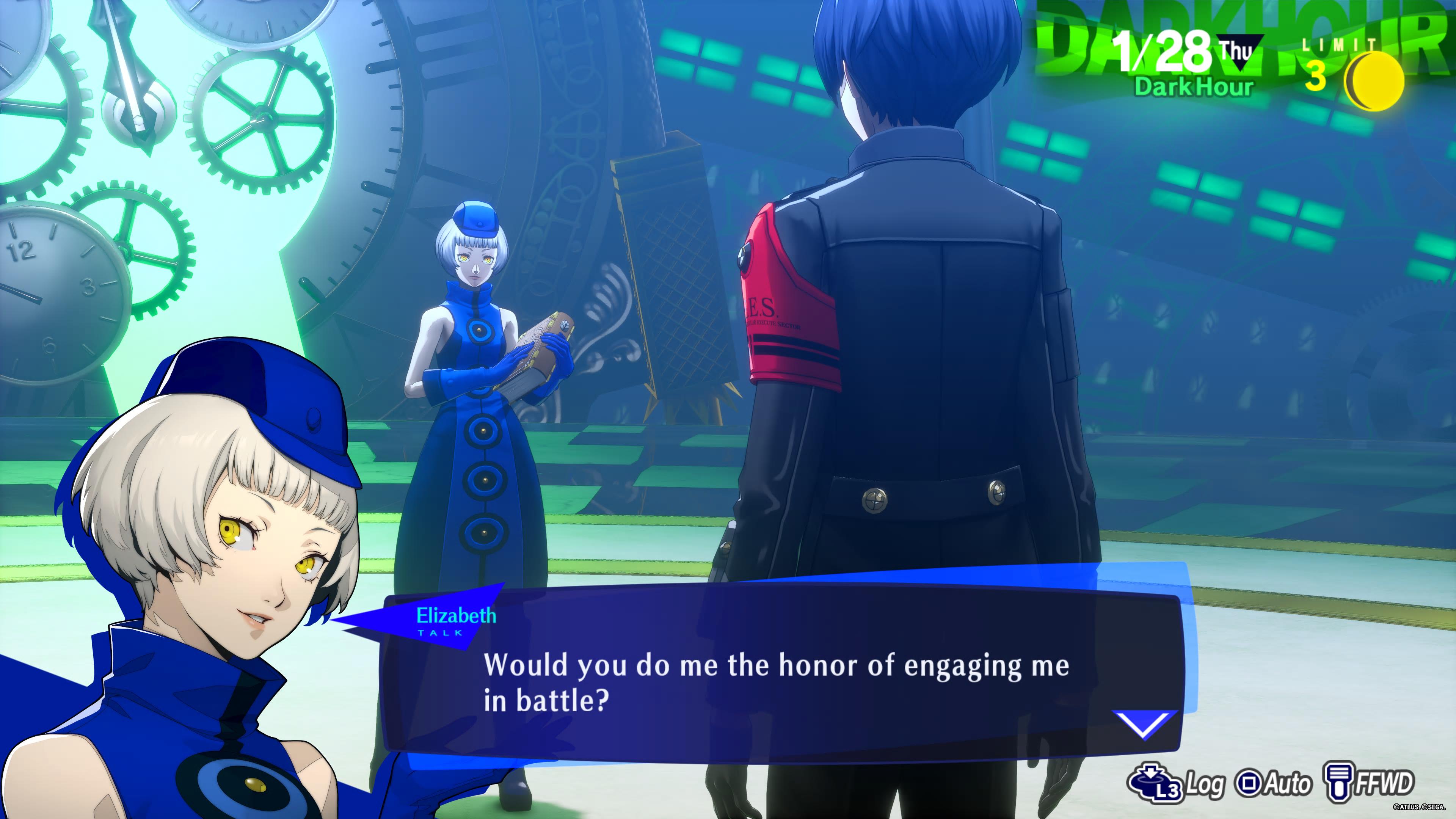
This isn’t DLC but it is proof I managed to beat “The Reaper”! I didn’t manage to beat Elizabeth however, I do have a limit in terms of how much grinding I’m willing to do for extra content, as it turns out.
As mentioned a couple of times now a major DLC is on the way in September titled “Episode Aigis: The Answer”, which is a modern remake of the epilogue from P3: FES. Leading into that though were DLC packs with Persona 4 and 5 Personas, outfits and music to use during the game.
Thoughts Now:
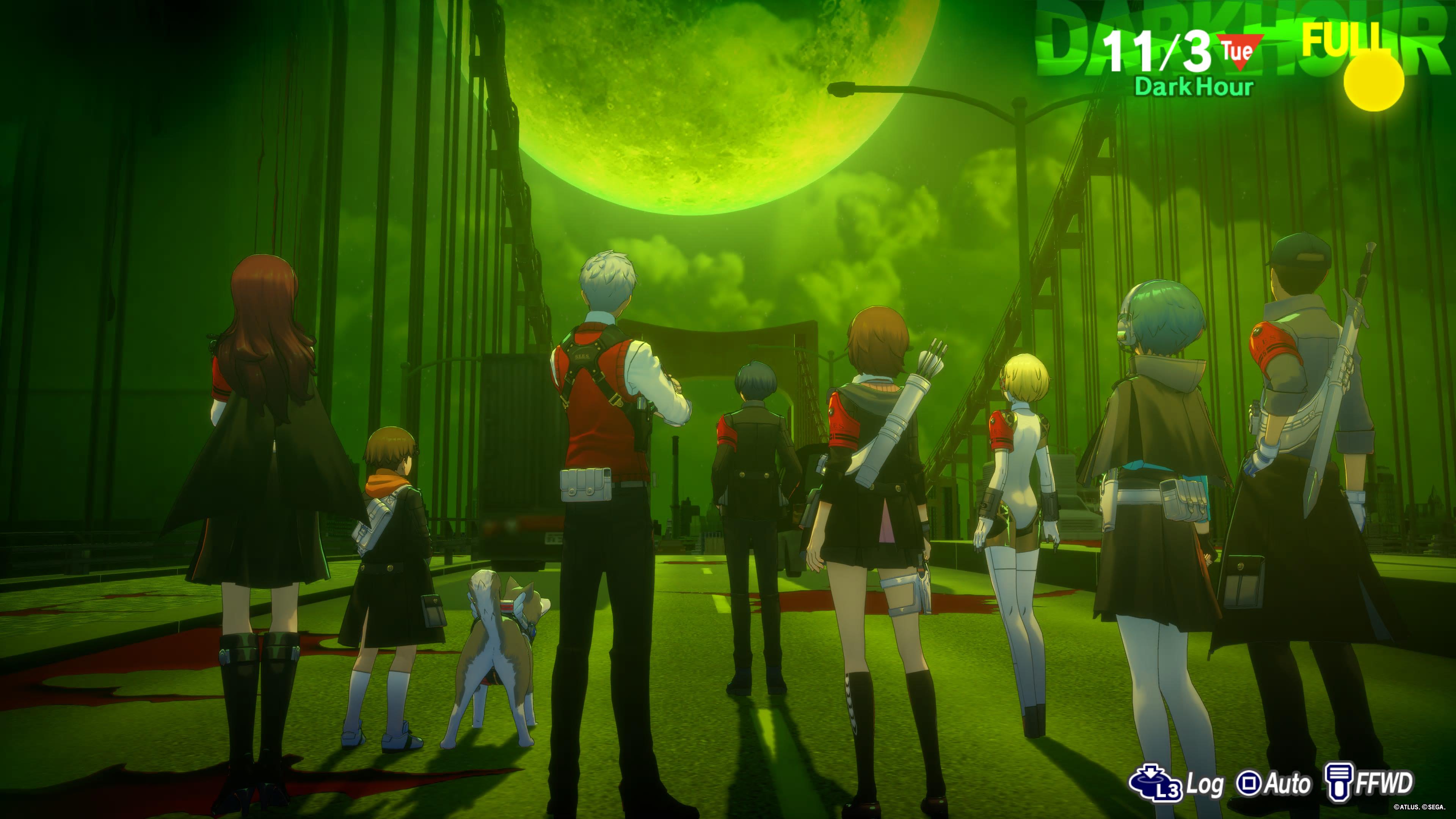
The entire playable cast staring at the eerie green moonlight, ready for the final battle.
3: Reload was a hell of a journey over the six-ish weeks I played it. Really fun, if not a little too easy (on normal difficulty) gameplay, the usual fun social life aspects, a great story and cast of characters to follow and stand-out presentation in all areas visual and audio. Hard to fault it really, so long as you like J-RPGs and have the time (which is something I mentioned not being interested in back in 2017, looking at my P3 movie reviews… funny how life can change in just seven years, I guess!)

 Hogan Reviews