
Well, given I have a couple of other on-and-off game review series going I wasn’t planning on starting another one, but while I knew it was always in the cards the sudden release of the Castlevania: Dominus Collection has shifted my priorities a bit as I’ve been waiting to play these games with a comfortable controller and on a big screen for many years. Sadly I’ll have to say that “Dawn of Sorrow” isn’t the massive hit I was expecting, in fact I think its prequel “Aria of Sorrow” was far better, that doesn’t mean this is bad by any means, just not up to that standard. Intrigued? Read on!
Background:

I thought I’d show a screenshot of the PS5 set up to show how it looks. The rest will just be the main screen… What?
Castlevania: Dawn of Sorrow was released exclusively on the Nintendo DS on August 25th 2005 in Japan, September 30th 2005 in PAL regions and October 4th 2005 in the US. Fast forward nearly two decades and the game was digitally re-released as part of the “Castlevania: Dominus Collection” on August 27th 2024 for the PS5, PS4, XBOX Series, Nintendo Switch and PC. It saw a dramatic shift is visual presentation as the game takes on a more anime-like style instead of the lovely gothic painting look the series has had since Symphony of the Night. It’s normally a style I enjoy but coming after such a fantastic and very fitting art style it’s a real downer.
I played a friend’s copy at the time and knew right away that the Magic Seal system would annoy me too much (see the gameplay section!) and never played it beyond the first half an hour, so I’ve spent decades thinking about emulation but never feeling right about it given I don’t own the game (and due to how expensive it is nowadays, will never likely own the DS original!) so I was thrilled to see the re-release be so close to the original, complete with the second DS screen at the side of the screen at all times. Proper on-console emulation of a series of DS games on the PS5 is something I wasn’t sure would happen, but I’m glad it did!
Gameplay:

Soma and The Creature go for that classic anime “punching each other’s fists” scene.
At its core it’s still very much an “action platformer” and obviously a “Metroidvania” to boot. You slowly uncover a map while attacking enemies and platforming, keeping an eye on your health bar and magic gauge, gaining access to areas previously unavailable by gaining new abilities and defeating bosses. You have stats that will level up as you gain experience or go up depending on the equipment you have, well, equipped and you can buy new equipment and health restoring items from a shop. It’s always a very satisfying formula and done very well here, as you’d imagine after so many great ones before it. Your methods of attack are with weapons, which can change from swords to whips to spears to even handguns, and all have a special move that take a little off of your magic when you do it. There are also special abilities once again gained by absorbing the souls of defeated enemies, with some souls being rarer than others. The “gotta collect ‘em all!” part of the “Tactical Soul” system was a major highlight of Aria and I was happy to see it back.
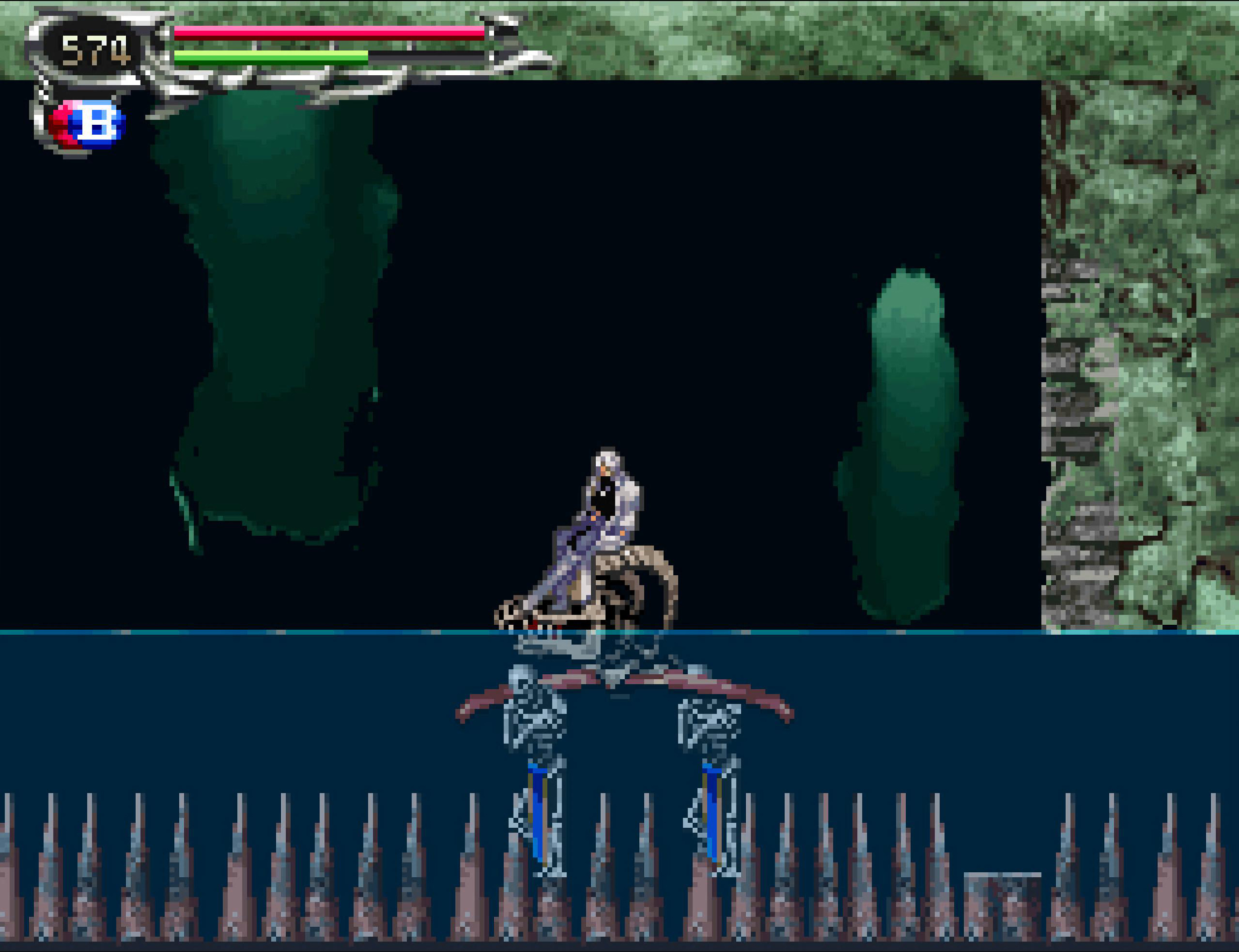
Avoiding the spike pit in style…
The Souls come in three main flavours, so to speak, allowing you to equip one of each kind: Bullet Souls are your extra offensive weapon that cost magic to use, including Axe Armour souls acting like the old Axe weapon from earlier games, all the way up to a devastating Mandragora plant that you can toss out like an explosive; Guardian Souls are familiars you can summon that drain your magic while they’re out but can give you an advantage like falling slowly, giving you a lift or just good old fashioned offensive moves, and in fact some Guardians can be combined with Bullet Souls to create “Tactical Soul Combos”; finally Enchant souls are buffs to stats that don’t drain any magic, basically a second set of armour but one that only increases one stat. You can have two sets of these three souls to switch between on the fly, as well as weapons and armour, so there’s less constant switching, which is handy. There is also a fourth type of soul, the Ability souls, but you only get them from defeating bosses and they give you new traversal abilities and such, which obviously don’t take up magic points to use and are always on, no need to swap out or equip them. As you continue to collect souls even after getting them once they have another catch to them: you can merge souls with the weapons in the game to upgrade them to the next level up. Souls can also be “released” which means they can then be used in a different mode called “Enemy Set” where you can build a custom scenario and share them with friends, but I’m not 100% sure that’s included in the Dominus version, but even if it is I can’t say it’s really my thing so I never touched it anyway…

Creating a path through the ice with the touch screen / touch pad. Mildly annoying, but far better than the other touch screen thing…
Sadly we now get to the negative part of the game: touch screen usage! Yes, this was the first Castlevania game on the DS so of course they went all in on the touch screen gimmicks, the worse offender being the Magic Seal System, where you have to draw a specific pattern on the screen to “seal” the bosses after defeating them. On the DS I can’t tell you frustrating it was, I can only imagine how bad it got towards the end where the seals get a lot more complicated to draw and you inevitably die to bosses you’ve technically already defeated because you failed to “seal them” properly. What a silly mechanic in retrospect, and at the time honestly. Thankfully the only real difference between the DS original and me playing it on the PS5 now is that for sealing you just have to press a combination of buttons in the right order, still occasionally annoying but far, far easier and therefore far less likely to have to redo the last moment of a difficult boss fight just because you slipped with your stylus a bit. There are other bits too, like ice blocks you have to clear by rubbing them off the screen but that was never done under pressure or anything, and it’s oddly perfectly recreated via the PS5’s touchpad, which is a part of the controller I’d never used for anything other than pressing it to open a select menu before but is surprisingly accurate.
As with Aria you can unlock “Julius Mode” once you complete the game (with either ending) but unlike the last game this time you play as Julius, Alucard and Yoko, a throw back to Castlevania III in a way (just without Grant, so I guess more of a preview of the animated show, I guess?) It’s quite a bit harder due to no Souls to manipulate (though Alucard and Yoko do come in handy for that) but at least you don’t have to draw any Magic Seals this time as Julius is so strong he annihilates the souls without needing to trap them, apparently. That’s why he’s the strongest Belmont!
So it has extremely solid gameplay and a fun collectable part to it but the touchscreen stuff and the anime visual overhaul knocks it below Aria in my eyes.
Graphics and Sound:

This amazing boss fight is one of the only uses of 3D objects that I don’t mind, only because fighting Gergoth as the tower collapses was really fun.
The graphics are a hard one to talk about. Obviously the sprites are bigger and more detailed than the GBA games, though not by a tonne, but I don’t like the more anime-style they went with even in the sprites, as well as the portrait images. I will say the backgrounds are lovely though, and some stages have nice effects like snow on cars that fall when you land on them, that sort of thing. Sadly some enemies are made with 3D graphics and therefore stand out like a sore thumb, but thankfully only one or two.
The soundtrack is of course great, that’s one thing that hasn’t changed with the hardware, and sound effects are also still very satisfying. Beyond Soma calling out a few things here and there the game is lacking any voices, which is far from the end of the world but I thought I’d mention it in case you thought the change to the DS might bring some cheesy Symphony of the Night voice acting with it.
Story:

Serious Wolverine vibes from Dario, bub.
After discovering he was the reincarnation of Dracula and helping beat back the dark entity that drove the vampire lord Soma Cruz returned to his normal life for a good year, then was confronted by a woman called Celia Fortner who leads a cult that believes the world needs an incarnation of darkness in order to balance the light and so wishes to force Soma to turn into the dark lord he was “destined” to, or have one of her candidates absorb his power and become the darkness incarnate instead. The two candidates, Dmitrii Bilnov and Dario Bossi were born on the day Dracula died and therefore have the potential to absorb Dracula’s soul should they slay Soma in battle. Celia summons a copy of Dracula’s castle and Soma is drawn there, meeting up with his old allies Julius Belmont, Yoko Belnades, Genya Arikado (Alucard…) and the merchant only known as Hammer. Soma sets out to stop the cult before they do something terrible, especially after they threatened his clearly-future-girlfriend Mina…
Spoilers from here until the next highlighted text!
Soma and co make there way through the castle, beating Dmitrii and Dario along with a whole host of other creatures, until Celia seemingly sacrifices Mina’s life in order to draw out Soma’s evil side. This either works, leading to the game’s bad ending, or if you’re wearing Mina’s necklace Soma resists long enough for Alucard to arrive and inform him that it was a fake and the real Mina is safe. Celia escapes further into the castle and we soon find out that Dmitrii had survived and thanks to his ability to copy other people’s powers he copied Soma’s Soul Domination ability and uses it to absorb Soma’s dark powers (and sacrifice Celia to do so) but he finds himself overwhelmed and unable to contain it, leading to a massive creature made up of all the enslaved souls collected by the cult to be created. Soma defeats the massive creature and escapes the castle as it crumbles, meeting up with all his allies outside for a happy ending…
Spoilers are over now!
As an excuse to have Soma and co. return despite the pretty definitive ending of Aria, it works well, and in spite of the anime visuals I really like Celia and her two candidates as villains.
Thoughts Now:
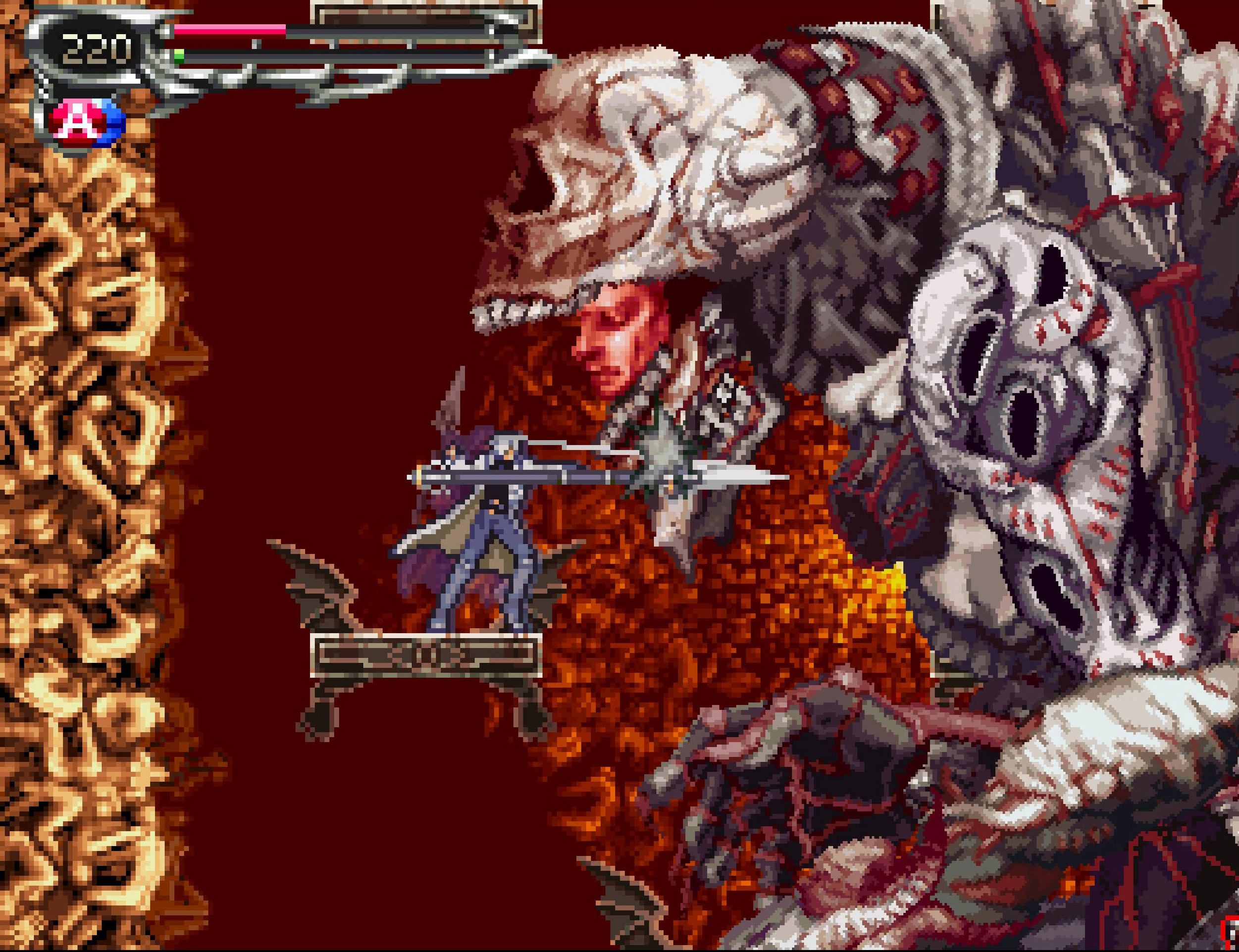
The final boss with not context at all. Freaky!
Castlevania: Dawn of Sorrow is a fun game, they’ve still got the “Metroidvania” style down and the Tactical Soul system’s collect-athon once again adds tonnes of fun to the already great formula, it’s just some touch screen nonsense and the change in visuals that knock it down a bit. Thankfully the former isn’t as bad on the PS5 as it was on the DS, but given we’re looking at the game as a whole I can’t overlook the Seal system and how poor of an idea it was. Still far from a bad game, naturally, but I can think of a few other Castlevania games I’d rate above it.

 Hogan Reviews