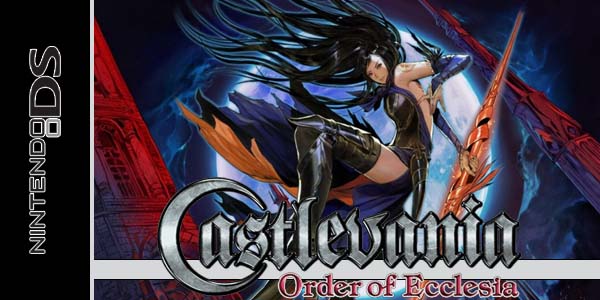
It’s time to wave goodbye to the “Metroidvania” style Castlevania games as we look at Order of Ecclesia, essentially the swan song of the original timeline/run of games, minus a few multiplayer and phone things anyway. It ends the series with a bang though, not just presentation-wise or gameplay-wise but also a “bang” in the sense of knocking into something hard as the game is really challenging, to put it politely. They knew the people playing at this point would be veterans rather than newcomers, I guess. Well, let’s take a look then, and bring an end to this particular brand of Castlevania on this site (I will get round to the classic and 3D games one day, I’m sure…)
Background:

Hello Creature my old frieeend. It’s time to kill you agaaaaain.
Castlevania: Order of Ecclesia was released exclusively for the DS on October 21st 2008 in the US, October 23rd 2008 in Japan, and February 6th 2009 in Europe, and there it stayed until the “Dominus Collection” was released for PS5, XBOX Series, Nintendo Switch and PC on August 27th 2024 worldwide. This particular one started going for silly money on the second hand market due to it not selling particularly well at the time, despite a more positive reception from critics. Over exposure I’d assume, after three GBA titles and two previous DS titles coming out so close together…
Gameplay:

A (very early) example of absorbing a Glyph, which I’ll talk about in a bit!
As always the game is a 2D side-scrolling action game, where you defeat enemies, do some platforming and defeat some bosses all while watching your health bar and levelling up your stats by gaining experience points for every enemy defeated as well as equipping items like armour. While this is still in the “Metroidvania” style it does depart from the formula quite a bit as instead of a central location to explore and having to unlock powers/items to get to new areas of old parts of the map you instead get a map of smaller areas and unlock new areas in a linear fashion, only needing to go back to old ones if your doing the optional side quests. There is a large castle at the end of the game that takes a good while to explore that’s a bit more like your traditional affair, but overall it does give the game a different vibe in the same way the paintings did in the previous game, which was probably needed after so many Metroidvanias in a row. You do still get some traversal gimmicks but they tend to be used in areas or boss fights rather than something to go back to old areas, as mentioned, and one of them, the Magnet Glyph, requires you to slide your finger across the touch screen and “fire” Shanoa, the main character, in a certain direction. Potentially fiddly, especially in the heat of battle, but luckily it’s the mid-2020s and we can now just use a standard controller without issue. Hooray!
So I mentioned Glyphs there, they’re the main gimmick for the game and act sort of like the Souls in Aria/Dawn of Sorrow, which is no bad thing! Every time you kill an enemy they have a chance to leave behind a Glyph which Shanoa can absorb into herself, granting her powers related to the enemy in question. They range from swords, axes and arrows to magic blasts, summoning creatures or passive buffs to stats, alongside the traversal ones mentioned earlier like the Magnet but also wings and such. You can equip three, one to each arm and one on her back, and the two you equip to the arms can be combined for quick combos and even special combined attacks that use up Hearts, which make their return to the series. Every weapon has a regular strike and a more powerful one and they all deplete Shanoa’s magic meter but the meter recovers very quickly so you’ll rarely be left with no way to defend yourself for more than a second or two.

Using Magnet to avoid the REALLY ANNOYING crab boss.
As you play through the game you can rescue villagers who then appear in the central hub area of the game where they can either act like a shop or give side quests in exchange for items. Much like Portrait of Ruin before it these side quests are rather dull, “Kill X amount of this enemy”, “take a photo of this enemy”, “collect six of this item and bring them to me” and so on, but thankfully they can be entirely skipped if you want. As is tradition at this point completing the game (either good or bad ending) nets you new modes post-game, like a Boss Rush, a harder difficulty and “Albus Mode”, the now traditional re-run mode where you play as a different character whose moveset makes things harder. The game also had a very basic online mode where you trade items or battle in a very bare-bones arena, but that was removed for the Dominus Collection re-release.
Overall it’s a really fun package thanks to tight and satisfying controls, a bit of a collect-a-thon with the Glyphs and fun level design (plus amazing art design and soundtrack, but I’ll get to that later…) I will say though, as alluded to in the opening paragraph, the game is hard, occasionally rock-hard to the point of getting annoying. An early boss against a giant crab was not only hard but really long, making replaying the battle a chore, and the final boss was quite the lesson in pattern memorisation. Still, I did it, and I’m not Mr. Amazing Gamer so it’s not “too hard” or anything, just prepare to bring some patience with you…
Graphics and Sound:

Nice use of shadows! … and of a giant wolf head Glyph!
After two games of not-very-attractive anime visuals Order of Ecclesia doubled down on the Symphony of the Night-to-Aria of Sorrow era gothic visuals instead, including the stages as well as the character artwork. It really makes the game feel more atmospheric and engaging.
The soundtrack is, unsurprisingly, once again top-notch. Lots of memorable tunes that can get stuck in your head, plus the sound effects and even voice work is good too (well, with the exception of the surfer-dude villager, who breaks the Victorian era mood a tad…)
Story:

This battle has strengthened the soul of… Shanoa!
The story focuses on Shanoa, a member of the “Order of Ecclesia”, a group dedicated to finding new ways to take down Dracula should he/when he reappears as the Belmonts have been gone for some time now (it’s set in the 1800s) A new method has been created by the Order’s leader Barlowe: the Dominus Glyphs, a series of three Glyphs that if all activated at once would completely destroy the demon. Shanoa agrees to have the Glyphs etched onto her but as the ceremony is taking place Albus, Shanoa’s adoptive brother, arrives and steals them for himself, the breaking of the ritual giving Shanoa memory loss as a side effect. A few weeks later Barlowe sends Shanoa out after Albus to reclaim the Glyphs and if necessary kill the traitor he thinks of as a son…
So for a good chunk of the game you’re chasing Albus across the land and even meet him on occasion, where he gives you one of the Glyphs as a “test”, then eventually you duel and win but things aren’t all as they seem as Albus’ memories flood into yours thanks to absorbing the Glyphs he was partially attached to.
Spoilers from now until the next bolded sentence!

Albus shows how much he loves his sister… (He is possessed by the Dominus at this point, for the record)
It turns out that using Dominus kills the wielder and upon finding not only this bit of information out but that his beloved sister was going to undergo the ritual instead of him led Albus to burst into the ceremony to save her by taking her place. Upon finding this out Shanoa confronts Barlowe (or accepts her fate, uses Dominus and dies if you want the bad ending for some reason) and finds out that he’s actually a devotee of Dracula and that Dominus will bring the Dark Lord back to life. Shanoa and Barlowe duel and she comes out on top, but his death has enough, um, evil power I guess…? to bring Dracula back anyway. Castlevania rises once more and Shanoa heads up the to the top to confront him after having to run the gamut of rooms and traps. The fight is close but it looks like Dracula is going to come out on top so Shanoa uses Dominus for its intended purpose and kills Dracula once more with it, but thanks to Albus’ spirit still inhabiting hers he is the soul sacrificed for its use, not Shanoa. Shanoa bids her brother a teary goodbye as all her memories return, before heading off for life anew.
Spoilers are over now!
It’s a fun little story with some good little twists, and given this is Castlevania is doesn’t need to be anything else.
Thoughts Now:

The Dance of the Skeleton Friskies. What better way to end the Metroidvania series of reviews?
Castlevania’s original run comes to a satisfying close as Order of Ecclesia is full of gothic atmosphere, great gameplay and a top-class soundtrack. Sometimes the difficulty hits “frustrating rather than fun” levels, but not often enough that I’d downvote it, just take a break for a day or two and come back to it, that’s what I do! Basically, while I’d still rate Symphony and Aria higher, the series at least went out on a near-highest high.

 Hogan Reviews